You Won’t Believe These Cultural Gems in Patan — Hidden Viewpoints That Changed My Trip
Patan isn’t just another stop on the Nepal circuit — it’s a living museum where every alley whispers history. I went looking for temples but found something deeper: viewpoints that reveal not just the city’s skyline, but its soul. From rooftop glimpses of bronze spires to quiet courtyards where time stands still, these spots offered me the real Nepal — raw, spiritual, and breathtakingly beautiful. This is what travel should feel like. More than a checklist of monuments, Patan invites you to pause, observe, and connect. In a world where destinations often feel commercialized or staged, this ancient city remains authentically alive. Its rhythms are set by prayer bells and artisan hammers, not tourist itineraries. What follows is a journey through the elevated perspectives that transformed my understanding of culture, heritage, and mindful travel.
Why Patan? The Cultural Heart of the Kathmandu Valley
Among the three historic cities of the Kathmandu Valley — Kathmandu, Bhaktapur, and Patan — Patan often stands out for its understated elegance and deep-rooted cultural continuity. Unlike its more widely publicized neighbors, Patan has preserved a quieter, more intimate atmosphere, where tradition is not performed for visitors but lived daily by its people. As one of the oldest continuously inhabited cities in Nepal, Patan was once an independent Newar kingdom, flourishing as a hub of trade, religion, and artistry between the 13th and 18th centuries. Its strategic location along ancient trade routes between India and Tibet allowed it to absorb and refine diverse artistic influences, resulting in a unique synthesis visible in its architecture, metalwork, and woodcarving.
The city’s significance is formally recognized by its designation as a UNESCO World Heritage Site, shared under the collective listing of the Kathmandu Valley. This status underscores not only the architectural grandeur of its monuments but also the living culture that sustains them. Patan remains a center for traditional craftsmanship, where bronze casting, stone sculpture, and intricate woodwork are still passed down through generations. Workshops tucked into narrow alleys produce items used in temples across Nepal, and apprentices can be seen chiseling deities under the watchful eyes of master artisans. This continuity makes Patan more than a historical relic — it is a working city where heritage is actively created, not merely preserved.
For travelers seeking meaningful cultural immersion, Patan offers a rare balance. It is accessible yet not overcrowded, rich in monuments yet unspoiled by mass tourism. While other heritage sites in the region have become dominated by souvenir stalls and fast-paced tour groups, Patan retains a sense of authenticity. Locals still gather in courtyards for festivals, monks walk barefoot to morning prayers, and artisans work in open-air studios. Choosing Patan as a destination means prioritizing depth over spectacle, engagement over observation. It is a place where the past is not behind glass but woven into the fabric of everyday life, inviting visitors to look beyond the surface and discover the enduring spirit of the Newar people.
Patan Durbar Square: More Than Just a Starting Point
No visit to Patan begins without stepping into Patan Durbar Square, the historic heart of the city and one of Asia’s finest concentrations of medieval architecture. Laid out in a harmonious blend of Hindu and Buddhist design, the square is a mosaic of temples, palaces, and courtyards that reflect centuries of artistic evolution. At its center stands the Krishna Mandir, a stone temple built in the 17th century in the South Indian style, its walls intricately carved with scenes from the Mahabharata. Nearby, the Royal Palace, known as the Krishna Narayan Temple complex, unfolds in a series of courtyards, each revealing layers of history, from ancient shrines to residential wings once occupied by royalty.
What makes Patan Durbar Square exceptional is not just its visual splendor but its dual role as both a tourist destination and a living cultural space. Unlike museum-like heritage sites frozen in time, this square pulses with daily activity. Locals circumambulate shrines with prayer beads in hand, children play near fountains carved with serpent deities, and shopkeepers open wooden shutters to begin their day. During festivals such as Indra Jatra or Machindranath Jatra, the square transforms into a stage for masked dances, chariot processions, and communal rituals that have been performed for generations. These events are not reenactments for tourists but genuine expressions of community faith and identity.
To experience the square at its most authentic, timing is essential. Early mornings, just after sunrise, offer the best opportunity to witness the city awakening. The air is cool, the light soft, and the space belongs more to residents than to visitors. Monks chant in temple courtyards, street vendors set up their stalls, and pigeons flutter between stone spires. On festival days, arriving early ensures a clear view of ceremonies without the press of crowds. Visitors are encouraged to observe respectfully — removing shoes before entering temple grounds, dressing modestly, and avoiding loud conversations near prayer areas. By approaching the square not as a spectacle but as a sacred public space, travelers can begin to understand the rhythm of Patan’s spiritual and social life.
The Roofline Revelation: Hidden Terraces Above the Old City
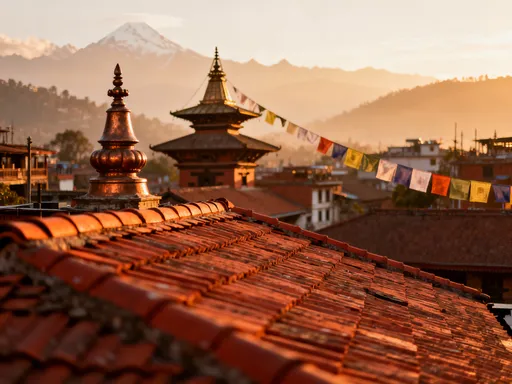
One of the most transformative moments of my journey came not at ground level but from above — from the rooftops and upper terraces of Patan’s traditional homes and monastic courtyards. From these elevated vantage points, the city reveals itself in a way that maps and guidebooks cannot capture. Endless waves of red-tiled roofs cascade toward the horizon, interrupted only by the golden tips of temple spires, fluttering prayer flags, and the occasional flutter of a clothesline in the breeze. It is a view that feels both intimate and infinite, offering a bird’s-eye glimpse into a world where architecture, spirituality, and daily life are seamlessly intertwined.
These hidden viewpoints are often found atop bahals — traditional Buddhist courtyard monasteries that serve as spiritual and social centers for the community. Many of these bahals have upper levels or adjacent homes with terraces that provide panoramic views. Some are accessible through cultural homestays, where guests are welcomed into family homes that have stood for generations. Others can be reached through community-led walking tours, which prioritize ethical access and local benefit. Unlike commercial observation decks, these spaces are not built for tourism but shared out of hospitality, making the experience all the more meaningful.
The act of climbing to these heights is more than a physical ascent — it is a shift in perspective. From above, the city’s layout becomes legible: the concentric courtyards, the narrow alleyways designed for shade and privacy, the way temples align with cardinal directions. You begin to see how every architectural choice reflects a deeper philosophy — one of balance, harmony, and reverence for the sacred. The sound of temple bells carries farther from this height, mingling with the distant hum of street life. It is a moment of stillness within motion, a chance to absorb the essence of Patan without intrusion. For those seeking such experiences, the key is respect — asking permission, following local guidance, and recognizing that these views are a privilege, not a right.
Golden Temple and the View from the Monastery Balcony
Few places in Patan embody the fusion of art, devotion, and perspective as completely as Hiranya Varna Mahavihar, commonly known as the Golden Temple. Located in the heart of Patan, this five-story Buddhist monastery is renowned for its gilded roof, intricately carved wooden struts, and walls covered in sacred murals. Built in the 12th century and restored over the centuries, the temple is dedicated to Akshobhya Buddha and serves as both a pilgrimage site and a center for monastic study. Its name, meaning “Golden Temple of the Golden Color,” refers not only to its shimmering exterior but also to the spiritual radiance it is believed to emit.
While the temple’s interior is a masterpiece of religious art, one of its most overlooked treasures is the view from its upper balconies. Climbing the narrow, hand-carved wooden stairs, visitors emerge onto open platforms that offer sweeping vistas of the surrounding neighborhood. From here, the geometric patterns of rooftops unfold like a mandala, with courtyards nestled between homes, monks walking in quiet procession, and temple spires rising like sentinels. The balcony provides a rare vantage point into the layered life of the city — the domestic, the devotional, and the artistic — all visible at once.
What makes this experience profound is the presence of daily monastic life. Unlike static museums, the Golden Temple is a living institution where monks chant, meditate, and study in rooms just steps from the viewing areas. Visitors are welcome to observe, but quietly and with humility. The sound of诵经 (chanting) drifts through the air, blending with the rustle of prayer flags. There is no separation between the sacred and the scenic; the view is part of the practice. For those who take the time to sit, breathe, and simply be, the balcony becomes more than a lookout — it becomes a place of reflection, where the external landscape mirrors the internal journey of awareness and gratitude.
Tribhuvan Museum’s Upper Galleries: A Quiet Lookout with History
Within the eastern wing of the Patan Royal Palace complex lies the Tribhuvan Museum, a lesser-visited gem that offers both historical insight and an unexpectedly serene perspective on the city. Named after King Tribhuvan, who played a pivotal role in Nepal’s transition to democracy, the museum houses a collection of royal artifacts, vintage photographs, and ceremonial objects that trace the evolution of the monarchy and its relationship with Patan’s cultural identity. While the exhibits are informative, it is the architecture of the museum itself — and its elevated position — that provides a unique vantage point.
The upper galleries of the museum run along open corridors with large arched windows and small balconies that look out over the palace courtyards, adjacent temples, and the bustling lanes below. From these windows, the city appears framed like a series of living paintings. You might see a priest lighting oil lamps at a shrine, a group of schoolchildren on a field trip sketching temple details, or a craftsman carrying a newly carved window frame to a restoration site. The perspective is not grand or sweeping like a mountain vista, but intimate and human — a reminder that heritage is sustained by daily acts of care and continuity.
What sets this viewpoint apart is its quietness. While Patan Durbar Square can grow lively by mid-morning, the museum’s upper levels remain calm, visited mostly by thoughtful travelers and local students. The light here is soft, filtered through wooden lattices, casting intricate shadows that shift with the sun. It is a space conducive to contemplation, where history is not just read but felt. Standing at one of these windows, you are simultaneously above the city and deeply within it — a witness to the quiet persistence of tradition. For those who appreciate museums not only as repositories of objects but as spaces of connection, this corner of Patan offers a rare synthesis of view, memory, and meaning.
Beyond the Center: Hillside Glimpses from Swayambhunath Road
While much of Patan’s magic unfolds within its ancient core, some of the most breathtaking views come from beyond its boundaries — particularly along the ridge road leading toward Swayambhunath, the iconic Monkey Temple perched on a hilltop west of the city. As you ascend this winding road, either by local bus, taxi, or on foot, the landscape shifts gradually, offering panoramic backdrops of Patan’s skyline framed against the Himalayan foothills. From this distance, the city transforms into a tapestry of terracotta, bronze, and green — a patchwork of rooftops, temple spires, and courtyards that seem to rise organically from the earth.
One of the most striking aspects of this view is how it reveals Patan’s harmony with its environment. Unlike modern urban sprawl, the city’s low-rise, high-density design preserves sightlines and maintains a human scale. The golden roofs of temples catch the sunlight like beacons, while prayer flags trace the wind’s path across the valley. During sunrise or golden hour, the entire scene glows in warm hues, creating a moment of stillness that feels almost sacred. Photographers and contemplative travelers alike find this vantage point especially rewarding, as it allows for a holistic appreciation of Patan’s architectural and spiritual landscape.
Reaching these viewpoints is straightforward and affordable. Local buses depart regularly from Patan Chowk and follow the route toward Swayambhunath, offering spontaneous opportunities to disembark at scenic spots. Taxis can be hired for a small fee, allowing for flexible timing and stops. For the more adventurous, walking the route provides time to absorb the changing scenery and interact with local vendors along the way. The best times to visit are early morning or late afternoon, when the light is soft and the air is clear. Regardless of how you arrive, the experience of looking back at Patan from this elevated ridge offers a powerful reminder: sometimes, the deepest understanding of a place comes not from being in it, but from seeing it whole.
How to Experience Patan’s Viewpoints Like a Local — Respectfully
The beauty of Patan’s hidden viewpoints lies not only in their visual appeal but in the way they invite mindful engagement. To truly honor these spaces, travelers must approach them with respect, awareness, and a willingness to listen. Ethical photography is a cornerstone of responsible visitation — always ask permission before photographing people, especially during prayer or private moments. Avoid using zoom lenses to capture intimate scenes from a distance, and never intrude on residential courtyards without invitation. Remember, many of these viewpoints are part of living homes and sacred spaces, not tourist attractions.
Dress codes matter deeply in Patan. Modest clothing — covering shoulders and knees — is expected when visiting temples, monasteries, and family homes. This simple act of respect opens doors, both literal and cultural. It signals that you are not there to consume but to connect. Similarly, removing shoes before entering homes or temple areas is a non-negotiable gesture of humility. These customs are not barriers but bridges — small acts that align you with the values of the community.
Supporting community-based tourism initiatives is one of the most impactful ways to give back. Choose homestays, local guides, and small cultural enterprises that reinvest in preservation and education. Many neighborhoods now offer walking tours led by residents who share stories, recipes, and traditions that never appear in guidebooks. By choosing these experiences, you contribute directly to the sustainability of Patan’s cultural ecosystem. Most importantly, slow down. Let the city reveal itself gradually. Sit in a courtyard. Listen to the rhythm of life. Allow moments of silence to deepen your understanding. The best views in Patan are not found on maps — they are earned through patience, presence, and respect.
Patan’s true beauty lies not only in what you see, but in how it makes you feel — connected, humbled, and awakened. These viewpoints are more than scenic stops; they’re windows into a culture that has endured centuries. By choosing to look deeper — and higher — travelers can honor Patan’s legacy while discovering their own sense of wonder. The best views aren’t just found. They’re earned.